

FAQ
About the most flexible Norwegian cybersecurity platform
Understanding SNOK® — common questions
Operational Technology (OT) security is a specialized field focused on protecting industrial automation and control systems (IACS) from cyber threats. It covers technologies that control critical infrastructure such as power grids, water treatment systems, and production lines in manufacturing facilities.
We offer the SNOK® platform, a cybersecurity monitoring system designed to detect early signs of intrusions. The solution consists of a unique combination of network sensors (NIDS), endpoint sensors, and PLC sensors, which together provide full visibility into the operational environment.
The risk has increased due to ongoing digitalization and the Industry 4.0 trend, which connects previously isolated production systems with IT networks. Cyberattacks have become a real threat to production continuity, employee safety, and the stability of public services.
IT security focuses primarily on protecting data, while OT security prioritizes the continuity of industrial processes and operational stability. OT systems often rely on legacy devices that do not support traditional security tools such as antivirus software or frequent updates to patch security holes.
Key frameworks include the international standard IEC 62443, the NIS2 Directive, and national cybersecurity regulations. Organizations often combine these standards with information security management systems such as ISO 27001.
The main reason is the abandonment of the “air-gap” strategy (complete isolation) in favor of remote access and data exchange. This creates new entry points for cybercriminals, who may paralyze systems for ransom or carry out sabotage.
The highest risk affects PLC controllers, HMI panels, operational servers, and control networks, which often represent “blind spots” for traditional security solutions which are now more exposed. Attacks in these areas can directly impact the physical parameters of industrial processes.
For food producers, the most critical threats are production downtime with a lengthy recovery process. Shorter production downtime involving perishable goods, theft of unique recipes and process parameters may also have significant impact. OT incidents may also lead to product contamination, posing risks to public health and brand reputation.
Risk mapping is performed through an Asset Discovery process, during which SNOK® identifies all endpoints and their communication patterns. Based on this, we deliver Security Status Reports that highlight weaknesses in the infrastructure and prioritize corrective actions.
The SNOK® system is designed as a non-intrusive solution, meaning it monitors traffic without affecting industrial processes. Installation is fast and does not require changes to the running critical infrastructure.
We use behavioral analysis and real-time anomaly detection to identify deviations from established “normal” operational patterns. SNOK® monitors traffic and endpoint behavior within control networks, detecting intrusion attempts that have bypassed firewalls or other perimeter defenses.
When a threat is detected, the system immediately generates alerts for response teams, providing precise data to locate and characterize the attack. Our Security Center offers expert support in incident analysis and remediation planning.
New regulations introduce mandatory risk management, incident reporting within 24 hours, and personal accountability of executive management for cybersecurity posture. Digital security must become an integral part of daily operations, not just an add-on.
According to new regulations such as NIS2, ultimate responsibility lies with top management. In practice, this requires close cooperation between IT, operational (OT) teams, and security specialists.
SNOK® integrates with systems commonly used by Security Operations Centers (SOC) or other IT incident handling teams such as SIEM or SOAR systems. This enables unified alarm management from multiple sources via API. This shared visibility across both levels helps prevent attacks from spreading from office networks to production environments.
The cost of prevention through continuous monitoring is only a fraction of the losses caused by downtime, equipment damage, or loss of public trust. Investing in prevention ensures operational stability and continuity of critical services such as energy or water supply.
SNOK® is a monitoring and detection system that supports the efforts under a security management system (e.g., an ISMS based on ISO 27001) to detect and prevent security incidents in a timely manner.
SNOK® is deployed within the industrial network using sensors that collect deep insights into traffic and device behavior.
The system is installed on premises and utilizes local sensors within the customer’s infrastructure. Detection is carried out locally, forwarding of events and alerts to other solutions is optional.
Even systems without internet access are vulnerable to internal attacks or infected removable media, which is why internal monitoring is essential.
The solution is hierarchically scalable—from small, unattended sites to large, distributed industrial plants.
SNOK® features a simple interface and requires only a short “learning period” to establish the normal behavior of the network.
Yes. The SNOK® platform is designed for flexibility and seamless integration. The system integrates with widely used SIEM platforms, allowing security experts to manage alarms and security events from multiple sources via a REST API. Alerts can also be forwarded directly to the customer’s local operational control centers.
Yes. Secure-NOK experts provide advisory support in OT cybersecurity programs and incident analysis. Our Security Center offers assistance ranging from basic guidance to analysis support during an incident and to your response efforts for customers who lack sufficient in-house expertise. In addition, several of our partners offer assistance during preparedness and contingency planning. (Beredskapsplan).
The key method for preventing attack propagation is effective network segmentation, meaning a clear separation between IT and OT networks and preferably also between different parts of the OT networks. SNOK® monitors both internal and external communications, detecting attempts to breach these boundaries. By placing sensors within control networks and at endpoints, attackers have minimal opportunity to establish a foothold needed to compromise other parts of the infrastructure.
The investment in a monitoring system is small compared to the costs generated by a successful attack. In critical infrastructure, tolerance for downtime is extremely low, and prevention costs represent only a fraction of the losses caused by production outages, equipment damage, risks to human safety, or loss of public trust.
In practice, incident handling begins with automatic, real-time early warning, enabling defenders to stop an attack before it causes physical damage. The detection system provides the information required to locate and characterize abnormal network behavior. In line with NIS2 requirements, organizations must maintain documented plans that cover not only detection and response, but also system recovery strategies following an incident.
The primary difference is that OT solutions must be non-intrusive so they do not disrupt industrial processes. Unlike in IT, suspicious messages in an OT system cannot simply be blocked without complete certainty that doing so will not impact normal operations. OT equipment could also be strained on resources or highly sensitive to network latency. Many OT devices (such as PLCs) lack built-in security features like antivirus software or encryption, and therefore greatly benefit from external non-intrusive monitoring—capabilities provided by SNOK®.
Get a quick OT security assessment with a 60-day SNOK® pilot, including a security report and optional hardware lease.
Gain full visibility into your OT environment — and know exactly where you stand.
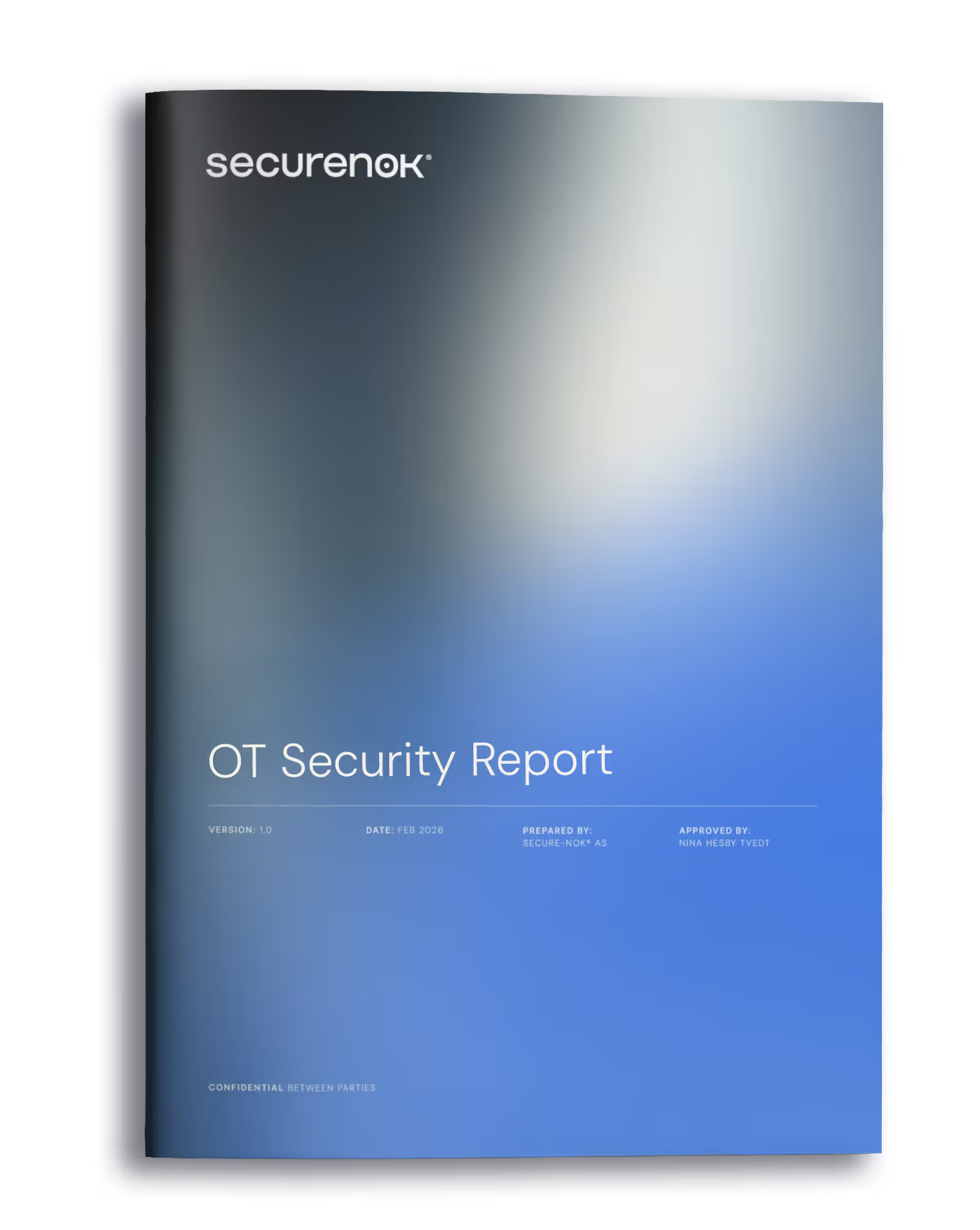
Full insight into OT assets and traffic
Reveals vulnerabilities and detects unwanted behavior
Actions: Concrete, prioritized recommendations
Fixed Price: 60-day SNOK license and report